
The choice between a natural loofah and a synthetic bath sponge might seem trivial, but it's actually one of the most impactful sustainability decisions you can make in your daily routine. With billions of plastic bath products ending up in landfills and oceans every year, understanding the true differences between these two options is more important than ever.
This comprehensive guide breaks down every aspect of the loofah vs synthetic sponge debate, from material composition and environmental impact to hygiene concerns and long-term costs. Whether you're considering making the switch to natural products or simply curious about the best option for your skin and the planet, this comparison will give you all the facts you need to make an informed decision.
What Is a Natural Loofah vs Synthetic Sponge?
Before comparing these two bath accessories, it's essential to understand exactly what each one is made from and how they're produced.
Natural loofahs (also spelled luffa) are the fibrous interior of mature loofah gourds (Luffa aegyptiaca or Luffa acutangula). These climbing plants are members of the cucumber family and can be easily grown in home gardens.
- Material: Cellulose plant fiber from dried gourd fruit
- Origin: Grown in tropical and subtropical regions worldwide
- Processing: Harvested when mature, then peeled, dried, and seeds removed
- Composition: 100% biodegradable natural cellulose
- Texture: Firm, slightly scratchy when dry; softens when wet
Synthetic bath sponges are manufactured from petroleum-derived plastics, primarily polyurethane foam or nylon mesh materials. They're designed to mimic the texture and function of natural sea sponges.
- Material: Polyurethane foam, polyester, or nylon plastic mesh
- Origin: Factory-manufactured from fossil fuels
- Processing: Created through chemical polymerization and foam production
- Composition: Non-biodegradable petroleum-based polymers
- Texture: Soft and squishy; maintains consistency when wet or dry
Material Comparison: Plant Fiber vs Plastic
The fundamental difference between loofahs and synthetic sponges lies in their material composition, which affects everything from how they feel on your skin to their environmental footprint.
Natural Loofah Material Properties
Natural loofahs are composed of cellulose fibers arranged in a network that creates their characteristic scrubbing texture. When dry, the fibers are stiff and provide excellent exfoliation. Once wet, they soften slightly while maintaining enough firmness for effective cleansing.
The fiber structure of loofahs contains natural antimicrobial properties, and the open network allows for excellent water drainage and air circulation. This prevents the buildup of moisture that can harbor bacteria. You can learn more about the skin benefits of natural loofahs and how the material affects your skin health.
Synthetic Sponge Material Properties
Synthetic sponges are made from polyurethane foam or mesh plastics that are designed to be soft and gentle on the skin. The foam structure holds water well, creating a luxurious lather with minimal soap. However, this same water retention can become a breeding ground for bacteria if not properly dried.
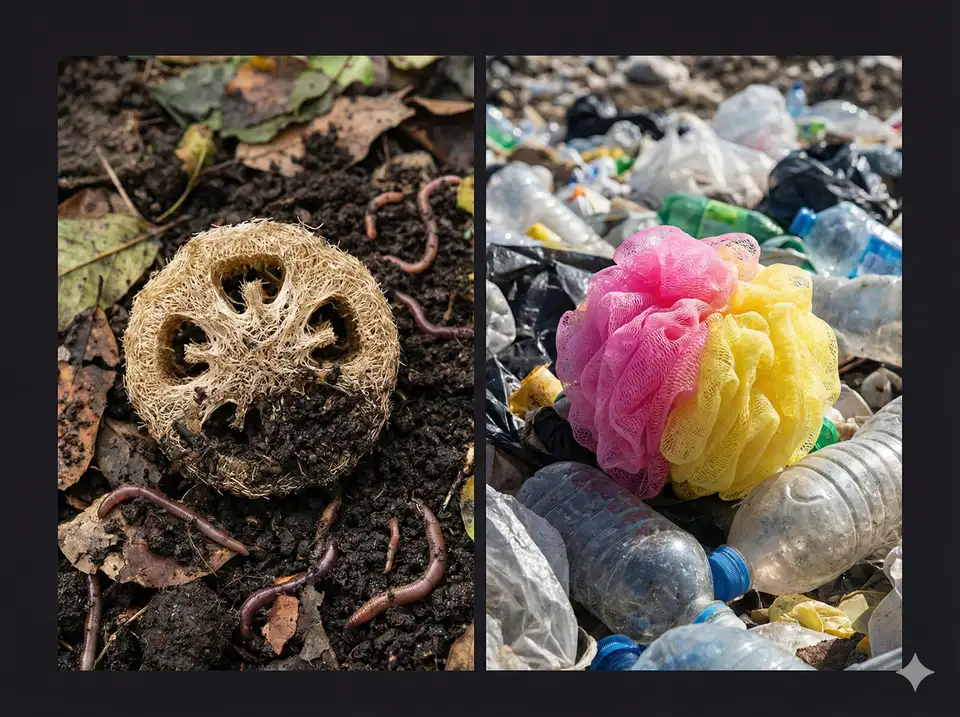
Unlike natural materials, synthetic sponges don't break down over time in the environment. They shed microplastic particles during use, which wash down the drain and eventually enter waterways and oceans.

Environmental Impact: The Critical Difference
This is where the comparison becomes stark. The environmental impact of natural loofahs versus synthetic sponges couldn't be more different.
- Carbon footprint: Plants absorb CO2 while growing, making them carbon negative
- Production: Requires only sunlight, water, and soil; no chemicals or factories
- Biodegradability: Fully composts in 30-60 days in home compost
- Microplastics: Zero microplastic pollution
- End of life: Can be composted or used as garden mulch
- Renewability: Completely renewable; can be grown at home annually
- Carbon footprint: High; requires petroleum extraction and chemical processing
- Production: Energy-intensive manufacturing with chemical emissions
- Biodegradability: Takes 500+ years to break down; never fully decomposes
- Microplastics: Sheds thousands of microplastic particles per use
- End of life: Goes to landfill or incinerator; can't be recycled
- Renewability: Non-renewable; depends on finite fossil fuel resources
- Global scale: An estimated 2.5 billion synthetic bath sponges are sold annually worldwide
- Microplastic pollution: Each synthetic sponge releases approximately 300,000 microplastic fibers during its lifetime
- Landfill waste: A single synthetic sponge takes up landfill space for centuries; a loofah composts in weeks
- Carbon savings: Growing your own loofahs eliminates transportation emissions entirely
The environmental differences are undeniable. Natural loofahs represent a truly sustainable choice, while synthetic sponges contribute to plastic pollution, microplastic contamination of waterways, and dependence on fossil fuels. Learn more about loofah's environmental benefits and how switching can reduce your plastic footprint.
Hygiene and Bacteria: Which Is Cleaner?
One of the most common concerns about bath sponges is bacteria growth. Both natural loofahs and synthetic sponges can harbor bacteria if not properly maintained, but there are important differences in how they behave.
Natural Loofah Hygiene
Natural loofahs have several inherent advantages when it comes to hygiene. The plant cellulose contains compounds that naturally resist bacterial growth—something I didn't fully appreciate until I compared my loofah to my old synthetic poufs under a blacklight. The difference was startling.
What makes loofahs particularly hygienic is their open fiber structure. Water drains quickly through the network of natural channels, and air circulates freely, which means they dry much faster than you'd expect. I've found that hanging my loofah outside the shower (rather than leaving it on a shelf inside) cuts drying time in half. When they do need sanitizing, you have options: boil them for 5 minutes, microwave them damp for 30 seconds, or toss them in the dishwasher. And here's the best part—when a loofah reaches the end of its life, you can compost it and grab a new one without any environmental guilt.
Synthetic Sponge Hygiene
Synthetic sponges face real hygiene challenges that stem directly from their material properties. That soft, squishy foam that feels luxurious? It's essentially a moisture trap. The closed-cell structure holds water like a reservoir, creating exactly the warm, wet conditions that bacteria love. In my experience, synthetic sponges take 2-3 times longer to dry than natural loofahs, especially in humid bathrooms where they may never fully dry between uses.
The sanitization problem is even more concerning. You can't boil a synthetic sponge—the heat will melt or warp the plastic. Microwaving isn't safe either. This means you're limited to surface cleaning that doesn't reach the deep foam pockets where bacteria can survive and multiply. I've noticed that people (myself included, before I switched) tend to keep synthetic sponges far longer than the recommended 3-4 weeks, partly because replacing them feels wasteful and partly because we don't realize how much bacteria has accumulated inside.
- For loofahs: Rinse thoroughly after each use, wring out excess water, and hang to dry in a well-ventilated area. Sanitize weekly by boiling for 5 minutes or microwaving damp for 30 seconds.
- For synthetic sponges: Rinse and squeeze out completely after use, hang to dry. Replace every 3-4 weeks maximum.
- Both types: Never share bath sponges; replace immediately if you notice odors or visible mold
- Best practice: Keep 2-3 loofahs in rotation, allowing each to fully dry between uses
For detailed guidance on keeping your loofah hygienic, see our complete guide on cleaning and caring for natural loofahs.

Exfoliation Effectiveness
Both natural loofahs and synthetic sponges can exfoliate skin, but they do so in very different ways and with varying levels of effectiveness.
- Texture: Firm, slightly rough fibers provide excellent dead skin cell removal
- Effectiveness: Superior for removing dry, flaky skin and improving circulation
- Adjustability: Becomes softer when wet; pressure can be easily controlled
- Coverage: Larger surface area covers more skin with each stroke
- Results: Noticeably smoother skin after first use; great for body exfoliation
- Best for: Rough areas (elbows, knees, feet), body exfoliation, improving skin texture
- Texture: Soft, smooth foam or mesh provides gentle cleansing
- Effectiveness: Minimal exfoliation; better for sensitive skin cleansing
- Adjustability: Limited; texture remains consistently soft
- Coverage: Smaller and softer; requires more passes over skin
- Results: Cleansing without significant exfoliation; luxurious lather
- Best for: Sensitive skin, gentle daily cleansing, creating rich lather
Winner for exfoliation: Natural loofah. If you're looking for effective exfoliation to improve skin texture, remove dead skin cells, and boost circulation, natural loofahs are significantly more effective. Synthetic sponges are better suited for gentle cleansing without aggressive exfoliation. Learn more about proper loofah exfoliation techniques for best results.

Durability and Lifespan
How long each type of sponge lasts depends on usage frequency, care practices, and quality of the original product.
Natural Loofah Lifespan
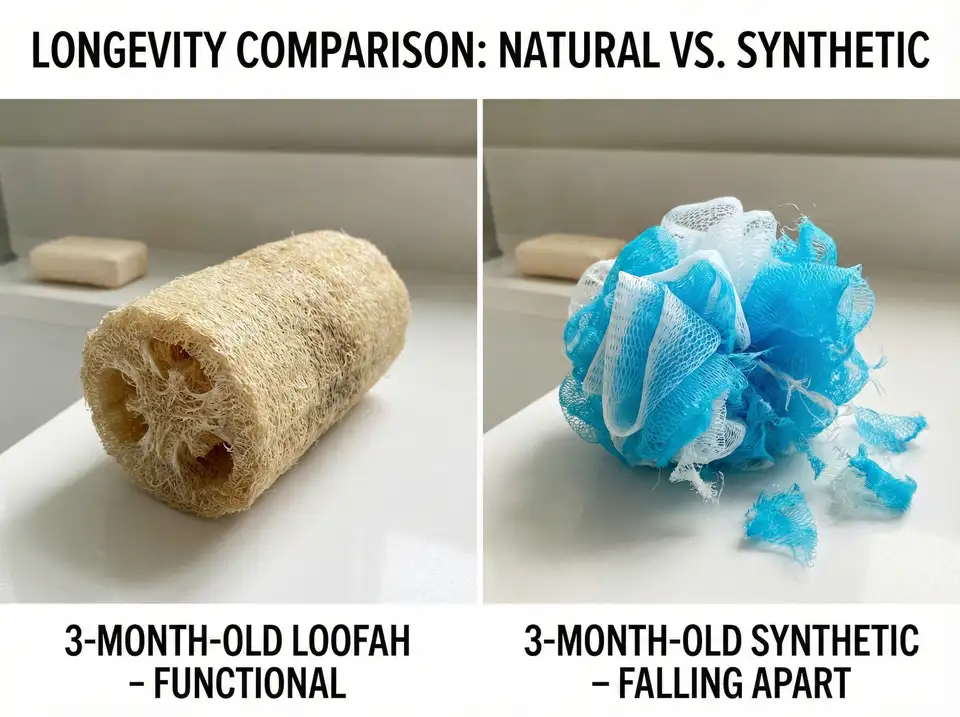
With proper care, a natural loofah typically lasts 3-6 weeks with daily use. I've found that rotating between 2-3 loofahs extends each one's life to 6-8 weeks because they get time to fully dry between uses. The key is letting them dry completely—a loofah that stays damp will break down much faster.
You'll know it's time to replace your loofah when it starts developing odors that don't go away after sanitizing, when fibers begin breaking apart in your hands, or when the texture becomes excessively soft and mushy. Weekly sanitization (a quick 5-minute boil or 30-second microwave while damp) significantly extends lifespan. Quality matters too—the thicker, denser loofahs from mature gourds outlast the thin, cheap ones you sometimes find at dollar stores.
Synthetic Sponge Lifespan
Synthetic sponges can physically last 4-8 weeks with daily use, but here's the catch: dermatologists and hygiene experts recommend replacing them every 3-4 weeks maximum, regardless of how they look. The problem is that bacteria accumulates inside the foam where you can't see it, so a sponge that looks perfectly fine may actually be harboring significant microbial growth.
Signs that you've definitely waited too long include persistent musty odors even after rinsing, visible discoloration or dark spots, and the foam starting to tear or fall apart. Unlike loofahs, synthetic sponges can't be thoroughly sanitized, so replacement is your only option. I've noticed higher-quality synthetic sponges resist tearing longer, but the hygiene clock is still ticking regardless of the brand.
Winner for durability: It's complicated. While synthetic sponges may physically last slightly longer, hygiene experts recommend replacing them sooner than loofahs. Natural loofahs can be safely sanitized and used longer when properly maintained. More importantly, when you grow your own loofahs, you have an unlimited supply, making durability concerns irrelevant.
Cost Comparison: Long-Term Value
At first glance, synthetic sponges might appear cheaper, but a comprehensive cost analysis tells a different story.
Synthetic Sponge Costs
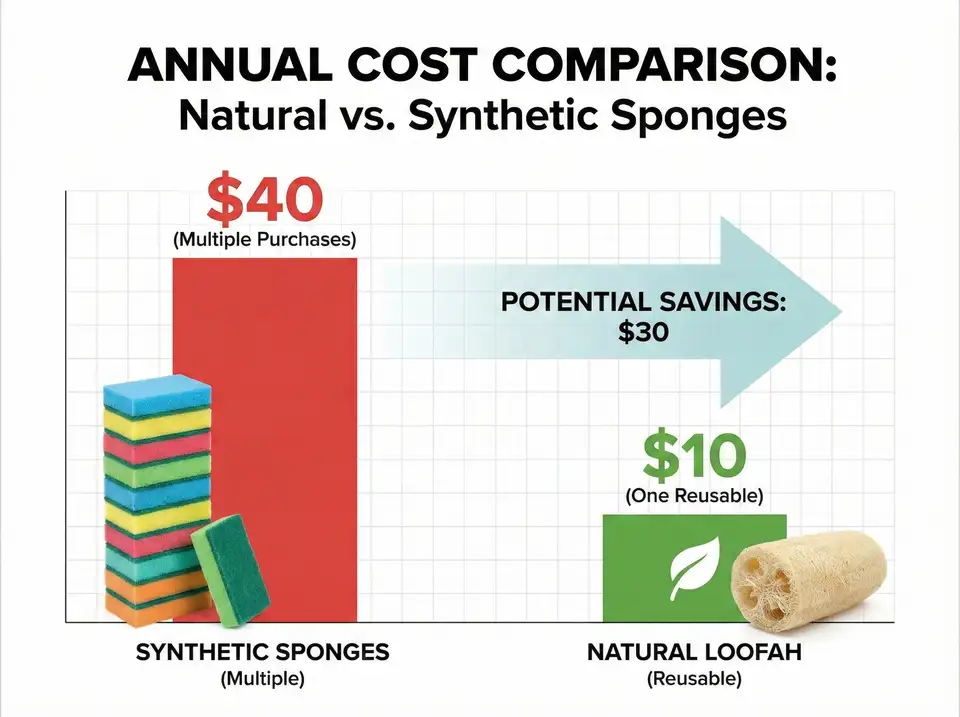
A typical synthetic bath sponge costs $2-5 at retail, with quality varying widely at those price points. The cheap ones from discount stores often fall apart within weeks, while premium brands last a bit longer but cost more. If you're following hygiene guidelines and replacing every 3-4 weeks, that's 13-17 sponges per year—adding up to $26-65 annually per person.
Over a decade, a family of four could spend $1,000-2,600 on synthetic bath sponges alone. And that doesn't account for the hidden costs: the environmental cleanup of microplastic pollution, the landfill space consumed for centuries, and the healthcare costs potentially associated with petroleum-based product exposure. These externalized costs don't show up on your receipt, but society pays them eventually.
Natural Loofah Costs
When bought individually, natural loofahs typically run $3-8 each—seemingly more expensive at first glance. But here's where the math gets interesting. Buy a 6-pack or 12-pack online, and the per-unit cost drops to $1-2 each. Since loofahs can be safely sanitized and used for 4-6 weeks (versus the 3-4 week maximum for synthetic), your annual cost comes to $15-50 per person.
The real savings come if you grow your own. After a one-time seed investment of $3-8 (which produces seeds for future years), each loofah costs roughly $0.10-0.50 when you factor in water and minimal garden inputs. A single vine can produce 10-20 sponges per season. I calculated my 10-year cost at under $5 total after my first harvest—compared to potentially $650+ for synthetic sponges. That's a savings of over $600 per decade, and you get the satisfaction of growing your own.
- Buy in bulk: Natural loofahs purchased in 6-12 packs cost 50-70% less per unit
- Grow your own: A single loofah vine can produce 10-20 sponges per season
- Seed saving: Save seeds from mature loofahs for perpetual free supplies
- Cut to size: One large loofah can be cut into 2-3 pieces, tripling your supply
Winner for cost: Natural loofah. Especially when purchased in bulk or grown at home, natural loofahs are significantly cheaper over time. A family that grows their own loofahs can save hundreds of dollars over a decade compared to buying synthetic sponges.
Skin Health Comparison
How each type of sponge affects your skin health is crucial for making the right choice for your body care routine.
Natural Loofah Skin Benefits
Natural loofahs offer several skin health advantages that go beyond simple cleansing. The firm texture stimulates blood flow to the skin surface—you can actually see the healthy pink flush after a good scrub. This improved circulation brings oxygen and nutrients to skin cells while carrying away waste products, which is why skin looks more vibrant after loofah exfoliation.
Where loofahs really shine is in mechanical exfoliation. They remove significantly more dead skin cells than synthetic alternatives, which makes them particularly effective for problem areas. If you struggle with keratosis pilaris (those bumpy "chicken skin" patches on upper arms), rough elbows, or callused heels, regular loofah use can make a noticeable difference within a few weeks. I've also found they're excellent for preventing ingrown hairs on legs—exfoliating a day before and a few days after shaving keeps those painful bumps at bay.
There's also the lymphatic drainage benefit when using proper technique (long strokes toward the heart), and perhaps most importantly, you're scrubbing your skin with pure plant fiber. No synthetic chemicals, no mysterious dyes, no antimicrobial additives—just natural cellulose from a gourd.
Synthetic Sponge Skin Considerations
Synthetic sponges do have one legitimate advantage: they're gentler. If you have sensitive skin, active eczema, rosacea, or other conditions where exfoliation causes flare-ups, the soft foam of a synthetic sponge provides cleansing without mechanical irritation. Sometimes gentle is exactly what skin needs.
However, there are concerns worth considering. Many synthetic sponges contain dyes (those bright colors aren't natural), fragrances, and antimicrobial chemicals that some people react to. There's also the microplastic question—synthetic sponges shed tiny plastic particles with every use. While research on skin absorption of microplastics is still emerging, some people prefer to avoid the exposure entirely. I've heard from readers who developed contact dermatitis from synthetic bath products and found their symptoms resolved after switching to natural alternatives. If you have unexplained skin sensitivity, your sponge could be worth investigating.
Winner for skin health: Natural loofah for most people. Unless you have extremely sensitive skin that can't tolerate any exfoliation, natural loofahs offer superior skin health benefits. They provide effective exfoliation without chemical exposure, improve circulation, and help maintain smoother, healthier skin.

Sustainability and Eco-Friendliness
We've touched on environmental impact, but let's dive deeper into the complete sustainability picture.
Natural Loofah Sustainability Profile
Growing loofahs actually improves your garden rather than depleting it. The plants add organic matter to the soil, and you can grow nitrogen-fixing companions like beans alongside them to enhance soil fertility for future crops. Water usage is comparable to tomatoes or cucumbers—nothing excessive for a garden vegetable.
What makes loofahs truly sustainable is the complete absence of waste. You can grow them organically without any pesticides or synthetic fertilizers. When they're spent, the sponge itself composts in weeks. The seeds can be saved for next year's crop or shared with friends. Even the outer skin and vine material break down quickly in a compost pile. Nothing—absolutely nothing—goes to landfill.
Growing your own also eliminates transportation emissions entirely. No container ships from overseas factories, no trucks to distribution centers, no last-mile delivery. Just walk to your garden and harvest. While they're growing, the plants are actively absorbing CO2 from the atmosphere, making them carbon negative. And those beautiful yellow flowers? They support bees, butterflies, and other pollinators throughout the growing season. It's one of the few products where production actively benefits the environment.
Synthetic Sponge Sustainability Profile
The sustainability story for synthetic sponges is essentially the opposite. Production starts with petroleum extraction—drilling operations that can contaminate groundwater, damage ecosystems, and release methane. The crude oil then travels to refineries for processing into the chemical precursors for polyurethane or nylon.
Manufacturing these plastics requires energy-intensive chemical processes that generate air and water pollution. Most synthetic sponges are manufactured in overseas factories, then shipped thousands of miles to distribution centers before final delivery to stores. Each step burns fossil fuels and generates emissions.
Then there's the end-of-life problem. Synthetic sponges usually come in plastic packaging (more waste), and during use they continuously shed microplastics into your wastewater—particles that eventually reach rivers and oceans. When you finally throw one away, it sits in a landfill for 500+ years, slowly breaking into smaller and smaller plastic fragments but never truly decomposing. They can't be recycled, so your options are landfill or incineration. There's no good way to dispose of them.
Winner for sustainability: Natural loofah by a landslide. There's simply no comparison. Natural loofahs represent one of the most sustainable body care products available, while synthetic sponges are among the least sustainable. By switching to loofahs, you can eliminate plastic waste from your bath routine entirely. Learn more about incorporating loofahs into a zero-waste bath routine.
Side-by-Side Comparison Table
Here's a quick reference comparing all the key factors:
| Factor | Natural Loofah | Synthetic Sponge | Winner |
|---|---|---|---|
| Material | 100% plant fiber (cellulose) | Petroleum-based plastics | Loofah |
| Biodegradable | Yes, composts in 30-60 days | No, persists 500+ years | Loofah |
| Microplastic Pollution | Zero | High (300k+ particles per sponge) | Loofah |
| Exfoliation | Excellent mechanical exfoliation | Minimal to gentle exfoliation | Loofah |
| Hygiene (with care) | Good; can be sanitized easily | Moderate; harder to sanitize | Loofah |
| Physical Durability | 3-6 weeks average | 4-8 weeks average | Tie |
| Cost (Purchased) | $15-50/year | $26-65/year | Loofah |
| Cost (Homegrown) | $1-5/year | Cannot grow | Loofah |
| Carbon Footprint | Carbon negative (absorbs CO2) | High carbon emissions | Loofah |
| Skin Benefits | Improves circulation, smooths skin | Gentle cleansing only | Loofah |
| For Sensitive Skin | Can be too harsh | Gentle and soft | Synthetic |
| Lather Creation | Good lather | Excellent lather | Synthetic |
| Renewable Resource | Yes, annual plant | No, finite fossil fuels | Loofah |
| End-of-Life | Compost or garden mulch | Landfill or incineration | Loofah |
Which Is Better for Different Uses?
While natural loofahs win in most categories, there are specific situations where each excels.
Natural Loofahs Are Better For:
- Body exfoliation: Removing dead skin, improving texture
- Rough skin areas: Elbows, knees, heels, calluses
- Circulation boost: Dry brushing or vigorous shower scrubbing
- Keratosis pilaris: "Chicken skin" on arms and thighs
- Pre-tanning prep: Exfoliating before self-tanner application
- Environmental concerns: Zero-waste, plastic-free bathing
- Budget-conscious: Especially when grown at home
- Kitchen cleaning: Dishes, counters (use separate loofah from body)
Synthetic Sponges Are Better For:
- Extremely sensitive skin: Conditions like eczema or rosacea
- Recent sunburn: Gentle cleansing without irritation
- Children's bath time: Soft and fun; less scratchy
- Rich lather creation: Creating luxurious foam with minimal soap
- Travel convenience: Lighter and faster-drying (though not eco-friendly)
Recommendation: For the vast majority of people and uses, natural loofahs are the superior choice. Only those with extremely sensitive skin conditions should opt for synthetic alternatives—and even then, consider using a washcloth or very soft natural sea sponge instead.
Making the Switch from Synthetic to Natural
Ready to make the transition? Here's how to successfully switch from synthetic sponges to natural loofahs.
- Start with one: Buy a quality natural loofah to test before committing to bulk purchases
- Soften it first: Soak in warm water for 5-10 minutes before first use to soften fibers
- Adjust pressure: Use lighter pressure than you think; loofahs are more effective than synthetic sponges
- Establish care routine: Rinse, wring, and hang after each use; sanitize weekly
- Give it time: Your skin may need 1-2 weeks to adjust to better exfoliation
- Buy in bulk: Once committed, purchase a 6-12 pack or start growing your own
- "It feels too rough": Soak longer before use; use when wet and with body wash for lubrication
- "It doesn't lather as much": This is normal; you need less lather for effective cleansing
- "My skin feels different": You're experiencing real exfoliation; skin should feel smoother in 1-2 weeks
- "It's hard to grip": Look for loofahs with attached cotton ropes or cut a hole and thread your own
- "I'm worried about bacteria": Follow proper loofah care practices; they're actually more hygienic than synthetic when cared for correctly
Growing Your Own: The Ultimate Sustainable Switch
The most sustainable and cost-effective option is to grow your own loofahs at home. A single vine can produce 10-20 sponges per season, giving you a lifetime supply with minimal effort.
- Easy to grow: Similar difficulty to growing cucumbers or squash
- Small investment: Seeds cost $3-8 and last for years
- One-time setup: After your first harvest, save seeds for perpetual free loofahs
- Suitable for most climates: Grows in zones 7-11; can be grown in containers in colder zones
- Multi-purpose plant: Young fruits are edible; flowers attract pollinators
Check out our comprehensive guide to growing loofahs to get started this spring.
Final Verdict: Natural Loofah vs Synthetic Sponge
After examining every aspect of this comparison, the winner is clear: natural loofahs are superior to synthetic sponges in almost every way.
Natural loofahs offer better exfoliation, superior skin health benefits, dramatically lower environmental impact, better long-term cost-effectiveness, and zero microplastic pollution. They're made from renewable plant resources, fully biodegradable, and can even be grown in your own garden for pennies per sponge.
Synthetic sponges only have two advantages: they're slightly softer (better for extremely sensitive skin) and create more lather. These minor benefits don't outweigh the significant environmental damage caused by plastic production, microplastic pollution, and landfill persistence for centuries.
- For most people: Switch to natural loofahs immediately for better skin and environmental benefits
- For sensitive skin: Try a softer natural sea sponge or washcloth instead of synthetic plastics
- For best value: Buy natural loofahs in bulk (6+ pack) or grow your own
- For maximum sustainability: Grow loofahs at home and compost used ones in your garden
- For everyone: Eliminate synthetic bath sponges from your routine to reduce plastic waste
Making the switch from synthetic sponges to natural loofahs is one of the easiest and most impactful sustainability changes you can make. Your skin will be smoother, your wallet will be fuller, and the planet will thank you for eliminating another source of plastic pollution from your daily routine.
Ready to experience the difference? Start with a quality natural loofah today, or plan to grow your own this coming growing season. Your skin—and the environment—will never look back.
Continue Exploring Natural Loofahs
Recommended Products
Almooni Egyptian Loofah Bath Sponges (3-Pack)
Premium thick-fiber natural loofahs - gentle exfoliation for all skin types - lasts 3-4 weeks each
Buy on Amazon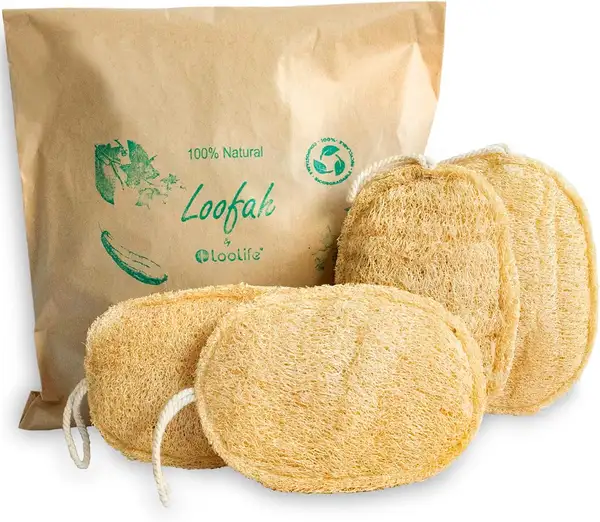
Natural Loofah Exfoliating Sponges (4-Pack)
100% organic biodegradable bath sponges - plastic-free alternative that's gentle on skin and planet
Buy on AmazonAs an Amazon Associate, we earn from qualifying purchases.